Why Coffee Gives You Jitters and Stomach Trouble — and What Low-Acid Alternatives Change

Two complaints send people searching for a different morning drink. One is the tight chest and racing pulse an hour after the first cup. The other is the stomach that turns before breakfast has even happened. Both usually get blamed on the same thing — acidity — and that diagnosis is mostly wrong.
Three separate mechanisms are at work: the acid your cup provokes rather than the acid it contains, the caffeine dose, and the timing of that dose relative to food. Products that compete on gentler numbers, HabitONE (https://habitone.co/) among them, aim at the first two of those levers. This article separates what the physiology supports from what a label can promise, so you can work out which lever is yours.
The Acid Myth: What Your Cup Actually Does
Brewed coffee sits between pH 4.85 and 5.13 across origins and brew methods, measured by Rao and Fuller (Scientific Reports, 2018). Stomach acid runs at pH 1.5-3.5 — hundreds of times stronger. Pouring a mildly acidic liquid into a far more acidic environment is not what produces the burn.
The real route is secretion. In gastric cells, chlorogenic acid and caffeine raised the expression of pro-secretory receptors and roughly doubled the proton-pump gene, measured by Rubach and colleagues (Annals of the New York Academy of Sciences, 2008); a separate family of compounds, the C5HTs, is implicated in the same direction. Your cup does not acidify the stomach; it instructs the stomach to make more acid.
That distinction matters commercially, because most of the category still markets “less acidity” while the measurable levers are roast chemistry, bean species and dose. The good news is that those levers move real numbers, which the next sections quantify.
Where the Gut Symptoms Actually Come From
Roast level changes the chemistry more than most drinkers expect. Rubach and colleagues (Molecular Nutrition and Food Research, 2014) compared two brews with matched caffeine in nine volunteers: the dark roast carried 87 mg/L of N-methylpyridinium against 29 mg/L in the medium roast, and far less chlorogenic acid – 323 against 1,126 mg/L. The dark roast stimulated significantly less gastric acid, because N-methylpyridinium suppresses the gastrin receptor rather than switching it on.
The lower gut responds too, and not to caffeine alone. Rao and colleagues (European Journal of Gastroenterology and Hepatology, 1998) used colonic manometry in 12 healthy adults and found that caffeinated coffee stimulated colonic motor activity comparably to a 1,000-kcal meal: 60% stronger than water and 23% stronger than decaf. Decaf still beat water, so something besides caffeine is driving the urge many people know well.
Cold brew deserves a caveat here. Its pH matched hot brew in the same 2018 measurements, though hot brewing extracted more total titratable acid. The researchers themselves warned against treating cold brew as a fix for stomach trouble — a useful reminder that a smoother taste and a gentler physiological effect are not the same claim.
The Jitters Are a Dose Problem
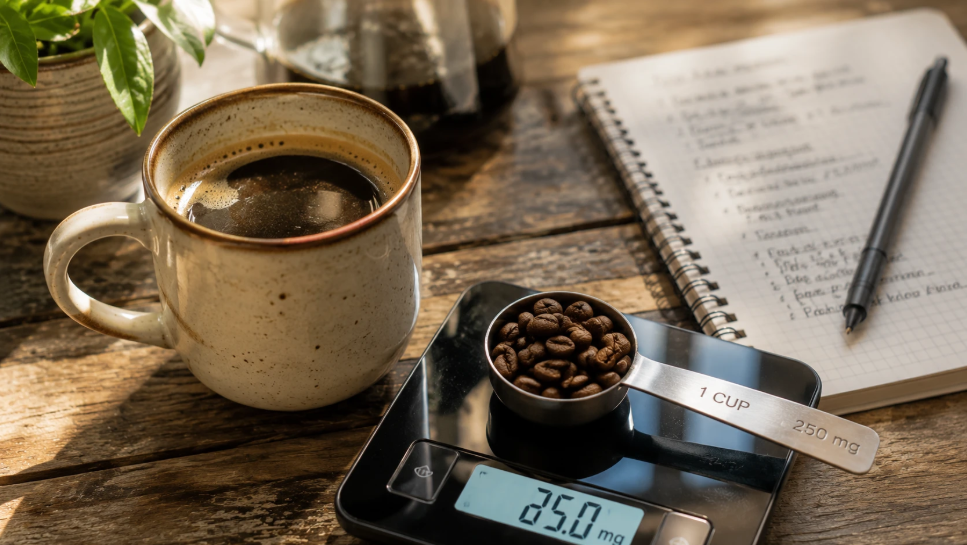
Regulators in the United States and Europe put the routine daily ceiling for healthy adults near 400 mg of caffeine. Symptoms, though, track the single dose and personal sensitivity far more closely than the daily total, which is why one 250 mg cup can feel worse than three 85 mg servings — the level HabitONE and similar blends settle on — spread across a morning.
Sensitivity has a documented genetic component. Childs and colleagues (Neuropsychopharmacology, 2008) linked variants of the adenosine receptor gene ADORA2A, notably rs5751876, to measurably greater anxiety after only 150 mg of caffeine. Variation in the CYP1A2 enzyme separately determines how slowly the dose clears, so two people drinking identical cups can be running very different blood levels four hours later.
At the clinical end, a meta-analysis put the panic-attack rate after 400-750 mg at about half of patients with panic disorder against 2% of healthy controls, while an everyday 150 mg dose left reported anxiety unchanged in both groups and raised only physiological arousal. The practical reading: the number on the pack is the first thing to change, not the last.
Drinking It Fasted: What Changes and What Does Not
The claim that coffee on an empty stomach damages the lining has thin support in healthy people, and it is worth saying plainly rather than repeating it. What does change is timing. Food slows gastric emptying, which flattens the caffeine peak instead of delivering it all at once, and it gives the acid the stomach was told to produce something to work on.
That is why the same cup can be uneventful after eggs and miserable at 7 a.m. on nothing. If your symptom is reflux or an urgent trip to the bathroom, the fasted cup is the most likely amplifier in your routine and also the cheapest variable to test.
The Three Mechanisms Side by Side
Laid out together, the mechanisms stop competing for the same blame and each points to a different fix. The evidence column below names the human study behind the mechanism, and the last column names the lever that actually moves it.
| Symptom | Mechanism | Human evidence | What changes it |
| Heartburn, burning, nausea | Stimulated acid secretion, not the drink’s own pH | Rubach 2014, nine volunteers, matched caffeine | Darker roast, lower chlorogenic acid, food alongside |
| Urgency, cramping, loose stool | Colonic motor activity, partly independent of caffeine | Rao 1998, manometry in 12 adults | Smaller volume, decaf or reduced dose, not fasted |
| Jitters, racing heart, anxiety | Single caffeine dose plus individual sensitivity | Childs 2008, anxiety response at 150 mg | Halving the dose per cup, later first cup |
| Afternoon crash, poor sleep | Slow clearance of a large morning dose | CYP1A2 metabolism studies | Total daily load, cut-off time |
Read across any row and the pattern holds: none of the three fixes is “less acidic water”. Each is a change in chemistry, dose or timing.
Low-Acid Coffee for a Sensitive Stomach: What It Changes
The term covers several genuinely different interventions, and their evidence is uneven. These are the levers behind the label, strongest first:
- darker roast — the best-supported option, with more N-methylpyridinium and up to 70% less chlorogenic acid than a medium roast;
- Arabica rather than robusta — naturally lower in both caffeine and chlorogenic acids;
- a smaller dose per cup, which addresses secretion and jitters at the same time;
- cold brewing — less total titratable acid, but no meaningful pH advantage;
- milk or food alongside the cup, which buffers and slows everything down;
- steam-treated or “acid-reduced” beans, where the processing is proprietary and rarely quantified.
Notice what is missing from that list: the pH of the finished drink barely moves. A low-acid coffee helps mainly by giving the stomach less to react to and by carrying less caffeine, which is a modest and honest mechanism rather than a cure.
Coffee Makes Me Anxious — What to Drink Instead
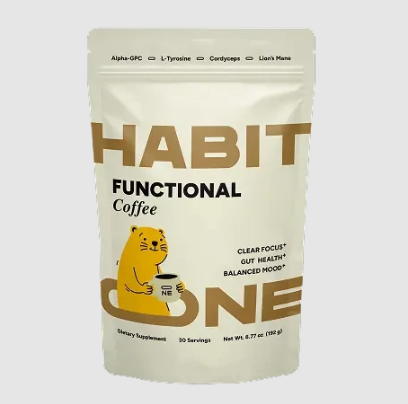
A low-acid Arabica blend at 85 mg of caffeine per serving
The options divide by how much of the ritual you want to keep. Decaf retains the taste and removes about 97% of the caffeine, though it still stimulates the colon. Tea and matcha deliver 30–70 mg per cup alongside L-theanine. Half-caf works because it halves the single dose, which is the variable that matters most.
Functional blends occupy the middle ground, and HabitONE is a workable illustration of the numbers involved: about 85 mg of caffeine per serving from 100% Arabica — roughly half a drip cup — with Reishi and Chaga in a base the brand describes as low-acid and gentle on digestion, at around 15 calories per scoop. Judged strictly, the caffeine figure is the part with a clear mechanism behind it; the gut claims for the mushrooms rest on tradition and animal work, since no controlled study in people has put a finished blend of this kind up against reflux or stomach symptoms.
That is the honest way to read any product in this space, HabitONE included: buy the dose and the bean, treat the rest as plausible but unproven.
A Two-Week Self-Test to Find Your Trigger
Because three mechanisms produce overlapping symptoms, changing everything at once tells you nothing. Change one variable at a time, in this order, and give each step three days.
- Keep your usual drink but move it to after food, and note whether burning or urgency drops.
- Halve the dose per cup — one scoop instead of two, or a smaller mug — while keeping the timing fixed.
- Switch to a darker roast or an Arabica-only blend at the same volume.
- Move your last caffeine of the day earlier by three hours and record sleep quality.
- Try three days without caffeine to establish a baseline, then reintroduce a single small cup.
Most people find their answer by step two or three, and the pattern is usually specific: reflux tracks food timing, urgency tracks volume, jitters track the single dose. Keep a two-line log each day, because memory smooths out exactly the details you need.
Where the Label Stops and a Clinician Starts
“Low-acid” is not a regulated term in the United States. Analytical work has found that most coffees marketed this way still measure well below the pH 5.5 threshold that researchers have proposed as a standard definition, so the phrase describes a taste profile and a positioning far more reliably than it describes chemistry.
Some symptoms also sit outside anything a beverage swap can address. Heartburn several times a week, pain that wakes you, unintended weight loss, difficulty swallowing, vomiting or black stools call for a doctor rather than a different mug — and if you take medication for reflux or an ulcer, the interaction with caffeine is worth asking about directly.
What to Change First Tomorrow Morning
If the problem is your gut, move the cup to after food and go darker on the roast. If the problem is your head, cut the single dose roughly in half and watch what happens over three days. Those two moves cover the majority of cases described in the research above, and neither requires giving up the ritual.
A low-acid coffee at a moderate caffeine level is a reasonable default for anyone who reacts to a standard cup, provided the expectation stays proportionate: it is a gentler input, not a treatment. The number that deserves the most attention is still the milligram figure on the pack, and a brand that prints 85 mg per serving, as HabitONE does, at least lets you compare before you buy.
These statements have not been evaluated by the Food and Drug Administration. These products are not intended to diagnose, treat, cure, or prevent any disease.