Action Cams for Diving and Hiking: What to Consider
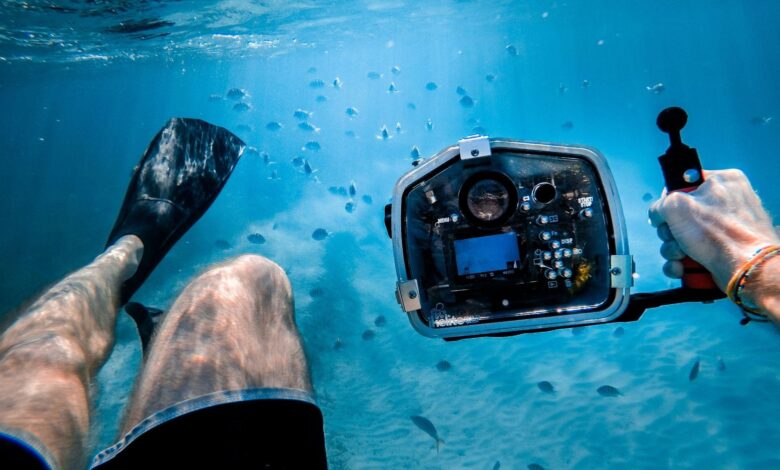
An action camera has to deal with two very different environments when it follows you from a mountain trail to the water.
Hiking demands low weight, effective stabilization, dependable battery life, and footage that handles changing light. Diving adds another set of concerns, including waterproof depth, underwater image quality, controls, and the need for a housing at greater depths.
There is no single camera that is objectively best for everyone. The more useful approach is to compare how each model handles the specific demands of both activities. Here are several current options worth considering.
DJI Osmo Action 5 Pro
Users seeking a single camera for both land and water activities will find the DJI Osmo Action 5 Pro particularly suitable.
Its 1/1.3-inch sensor, 4K recording at up to 120 fps, and electronic stabilization provide a strong combination for moving footage on trails. It also has 47GB of built-in storage, which can be useful when carrying limited equipment.
Strengths:
- Waterproof to 20 meters without a case
- Up to 60 meters with DJI’s Waterproof Case
- Large 1/1.3-inch sensor
- Strong battery performance under specified conditions
- Lightweight at 146g
- Built-in storage
Caveats:
- 4K is the maximum standard video resolution, so it does not offer the higher-resolution recording available from some competitors.
- DJI recommends a waterproof case for prolonged underwater shooting or situations involving high water pressure.
- Real-world battery life will vary considerably with resolution, stabilization, screen brightness, temperature, and other settings.
For someone who regularly alternates between hiking and recreational diving, its combination of relatively low weight and deeper native waterproofing makes it a practical all-rounder.
GoPro HERO13 Black
The GoPro HERO13 Black remains a conventional choice for hiking and water-based activities. It records at up to 5.3K60 and 4K120, while HyperSmooth 6.0 stabilization is designed to keep footage steady during movement. Its tall 8:7 sensor also allows footage to be adapted for different aspect ratios during editing.
Strengths:
- 3K video provides additional resolution for cropping
- Effective stabilization for walking and action footage
- Wide selection of mounting and lens accessories
- 10-bit HLG HDR support
- Waterproof to 10 meters without a housing
- Waterproof housing extends its depth rating to 60 meters
Caveats:
- Its 10-meter native waterproof rating is lower than DJI’s 20 meters.
- Deeper diving requires the separate protective housing.
- Additional lens mods and accessories increase both cost and carrying weight.
- Battery performance depends heavily on recording settings. GoPro states more than 1.5 hours of continuous recording at 4K30 and 5.3K30 under specified conditions.
Its extensive accessory ecosystem can be useful for hikers who want different mounting positions.
However, that flexibility can also turn a compact camera setup into a surprisingly large pile of tiny things humans somehow manage to lose.
Insta360 Ace Pro 2
The Insta360 Ace Pro 2 takes a somewhat different approach. It combines a 1/1.3-inch sensor with up to 8K30 recording, 4K120 video, and a flip touchscreen. Its 12-meter waterproof rating makes it suitable for swimming, snorkeling, and shallower dives, while a dedicated dive case extends the rating to 60 meters.
Strengths:
- 8K recording for users who want additional cropping flexibility
- 4K120 slow-motion recording
- Large 1/1.3-inch sensor
- Flip touchscreen
- 12-meter native waterproofing
- 60-meter rating with the dive case
Caveats:
- 8K recording is not necessarily the most practical setting for everyday use because it demands more storage and processing.
- Native waterproofing is below the DJI Osmo Action 5 Pro.
- Battery performance varies substantially by recording mode. Insta360 lists approximately 100 minutes under certain 4K conditions.
- Its larger body may be less convenient for users prioritizing minimal weight.
The Ace Pro 2 is therefore more interesting for hikers and divers who also care about editing flexibility and higher-resolution footage.
Insta360 X5
The Insta360 X5 is built differently from other cameras in terms of recording ability.
It records 360-degree footage rather than simply pointing one lens in a fixed direction. That can be particularly useful on hikes, where users can capture the surroundings and decide afterward which perspective to use.
It records 8K 360-degree video and is waterproof to 15 meters. With the Invisible Dive Case, Insta360 rates it for depths of up to 60 meters. Its FlowState stabilization and 360-degree Horizon Lock are designed to keep footage level while the camera is moving.
Strengths:
- 8K 360-degree recording
- 15-meter native waterproofing
- Up to 60 meters with the dive case
- Strong stabilization and horizon leveling
- Replaceable lenses
- Useful for reframing shots after recording
Caveats:
- 360-degree footage requires more editing than conventional action-camera footage.
- The camera weighs around 200g, making it heavier than some conventional action cams.
- Underwater 360 recording can experience stitching problems because water changes how light passes through the lenses. Insta360 recommends its Invisible Dive Case for better underwater stitching.
- The dual-lens design requires more care around exposed lenses.
What Should You Look For?
Alt text: A black camera on a tripod on a grass field during daytime
Photo by Marek Piwnicki on Unsplash
For a camera that will spend roughly equal time on hiking trails and underwater, waterproofing, weight, stabilization, battery life, and low-light performance deserve more attention than headline resolution alone.
The DJI Osmo Action 5 Pro offers an advantage for users who prioritize native waterproofing and long operating time.
The HERO13 Black makes sense for those who value stabilization, higher-resolution conventional footage, and a broad accessory ecosystem.
The Ace Pro 2 is better suited to people interested in high-resolution recording and flexible framing, while the X5 offers a fundamentally different shooting experience through 360-degree capture.
Whichever model you choose, remember that manufacturer battery and waterproof ratings are measured under particular conditions. Diving, cold weather, high recording resolutions, and frequent screen use can all change real-world performance.
Treat the specifications as a starting point rather than a guarantee. Much like a game of Bingo, having the right setup improves your chances of getting the result you want, but conditions still matter.
For diving specifically, it is important to check the seals, ports, lens covers, and housing requirements before entering the water.
A camera rated as waterproof is not necessarily designed for every depth or duration, and underwater repairs become considerably less convenient than discovering the problem on dry land.