Are LED Post Top Lights Better Than Traditional Outdoor Lights?
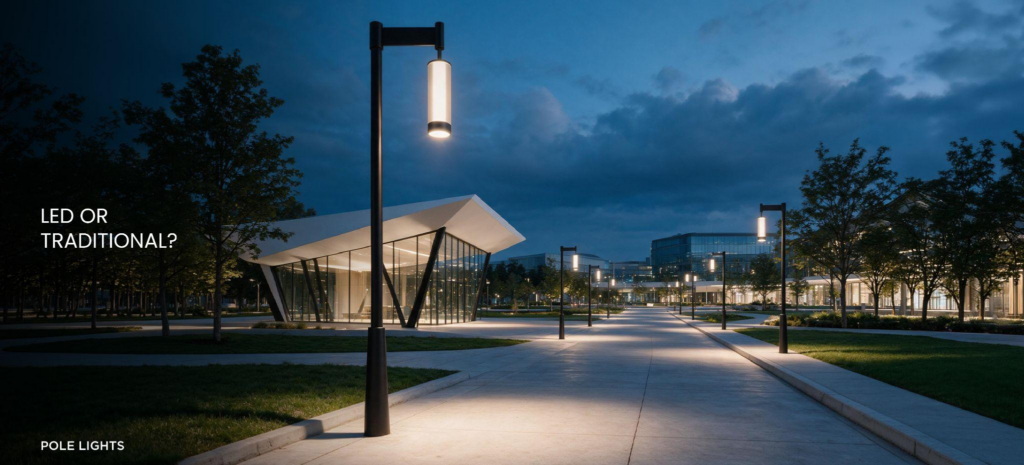
For the longest time, outdoor lighting existed for one purpose: to provide enough brightness to see by, with little thought given to how the fixture actually looked. That approach has changed considerably. Outdoor lighting today is expected to deliver on aesthetics just as much as function, often becoming a design statement in its own right.
Ayodhya’s Ram Path reflects this shift clearly, where 110 custom ornamental poles carrying motifs inspired by the city’s heritage were installed alongside standard street lighting, turning a functional stretch of road into something people notice and remember. Jaquar’s LED post top lights bring that same thinking to outdoor spaces around villas, bungalows and other residential properties, and this article breaks down how they actually compare to traditional lighting.
Why Are LED Post Top Lights Better Than Traditional Outdoor Lights?
LED technology has transformed outdoor lighting, offering greater efficiency, longer-lasting performance, and more consistent illumination than traditional lights.
Superior Energy Efficiency
Energy efficiency is one of the biggest gaps between traditional and LED lighting, and it shows up clearly in the numbers. A 40W LED post top light can deliver up to 3,600 lumens, close to 90 lumens per watt, while even a 35W fixture manages around 2,100 lumens, well above what a traditional bulb of the same wattage produces. Run a few pole lights along a driveway or garden path, and that efficiency gap turns into a real difference on the electricity bill.
Brighter and More Consistent Illumination
Uneven light is the giveaway of an ageing traditional bulb, patches of brightness next to patches of near-darkness, even while the bulb is technically still working. Precision optics inside LED post top lights avoid this by spreading illumination evenly across the ground. The result for outdoor pole lights is simple: the whole area stays visible, not just the spot directly under the fixture.
Greater Durability for Outdoor Conditions
Outdoor fixtures face rain, dust, UV exposure, and temperature swings that shift by the hour in some regions, and they deal with all of it daily. That constant exposure is exactly why an IP65 rating or above has become the baseline for LED post top lights, keeping water and dust out of the internal components. Certain ranges push further still, reaching IP66 or IP67 for added protection.
Environmentally Friendly Lighting Choice
LED post top lights consume significantly less power than traditional outdoor lighting and contain no mercury, making them a more sustainable choice. With a lifespan of up to 50,000 hours, they continue performing reliably for years before replacement even becomes a consideration. Fewer replacements over time also mean less waste heading to landfill, which is not a small detail when you’re lighting an entire garden, driveway, or residential community.
How to Choose the Right LED Post Top Lights for Your Outdoor Area?
Five factors decide whether a fixture performs well or disappoints within a year. None of them is complicated, but skipping any one of them tends to show up fast.
Choose Energy-Efficient and Long-Lasting LED Technology
A good post top light should hit close to 120 lumens per watt and run for up to 50,000 hours without needing a replacement. A power factor above 0.95 keeps energy loss to a minimum, and a CRI above 70 makes sure colours under the light look natural rather than washed out. These four numbers, efficacy, lifespan, power factor, and CRI, tell you more about a fixture’s real-world performance than the price tag ever will.
Select the Right Colour Temperature (CCT)
The right colour temperature depends on both the location and the purpose of the light. For gardens and driveways, a warm white range of 2700K to 3000K creates a softer, more inviting glow that complements the outdoor setting. Pathways and entrances usually call for something closer to 4000K through 6500K, neutral to cool white, where clarity takes priority over ambience.
Look for an Appropriate IP Rating
No outdoor fixture should sit below IP65. That rating protects against rain, humidity, and dust as a baseline requirement, not an upgrade. Coastal areas or regions with heavy monsoon rainfall need IP66 or higher, and this is one spec worth refusing to compromise on.
Consider the Material and Build Quality
A post top light’s housing decides how it ages. Aluminium bodies resist corrosion. Tempered glass resists impact. UV-stabilised coatings stop the surface from clouding after repeated sun exposure. Skip any of these, and two monsoons in, the fixture looks and performs like it’s ten years old.
Match the Light Output and Design to Your Space
Measuring the space first prevents almost every common mistake. Narrow pathways call for lower wattage and a tighter beam angle. Larger gardens need higher lumen output paired with a wider spread, and getting this wrong leaves part of the area sitting in shadow regardless of how good the fixture itself is.
Conclusion
Less power, less maintenance, fewer replacements across its lifetime- that’s what LED post top lights consistently deliver over traditional outdoor lighting. Wattage, CCT, and IP rating remain the three numbers worth checking before choosing outdoor pole lights for any space. Jaquar’s range of post top and pole lights is built around all three, with high IP protection and materials designed for years of outdoor exposure without losing performance. Get that choice right early, and garden pole lights keep doing their job long after cheaper alternatives have already failed.