GEO Explained: Generative Engine Optimization and the 5C Test
Where the Term GEO Came From
Generative Engine Optimization, or GEO, became a defined research term with the paper “GEO: Generative Engine Optimization,” first released as a preprint in 2023 and later published at KDD 2024. The paper did not prove a universal recipe for AI citations. What it did show was more useful: changes to content can affect how visible that content becomes inside generative answers, and the effect varies by topic and method.
That distinction matters in The AI Visibility SEO & GEO Playbook. Scharfenberg uses the research as a starting point, then separates established SEO practice from evidence-backed GEO patterns and from techniques that are still too new to treat as settled. In a field full of confident claims, that hierarchy is worth keeping.
The original GEO experiments reported visibility gains of up to roughly 40% on their benchmark. Strategies involving reliable citations, quotations and statistics were among the approaches that performed well, while keyword stuffing contributed little. The important qualifier is in the study itself: results varied by domain. “Up to 40%” is a benchmark result, not a promise for a live website.
SEO and GEO, Side by Side
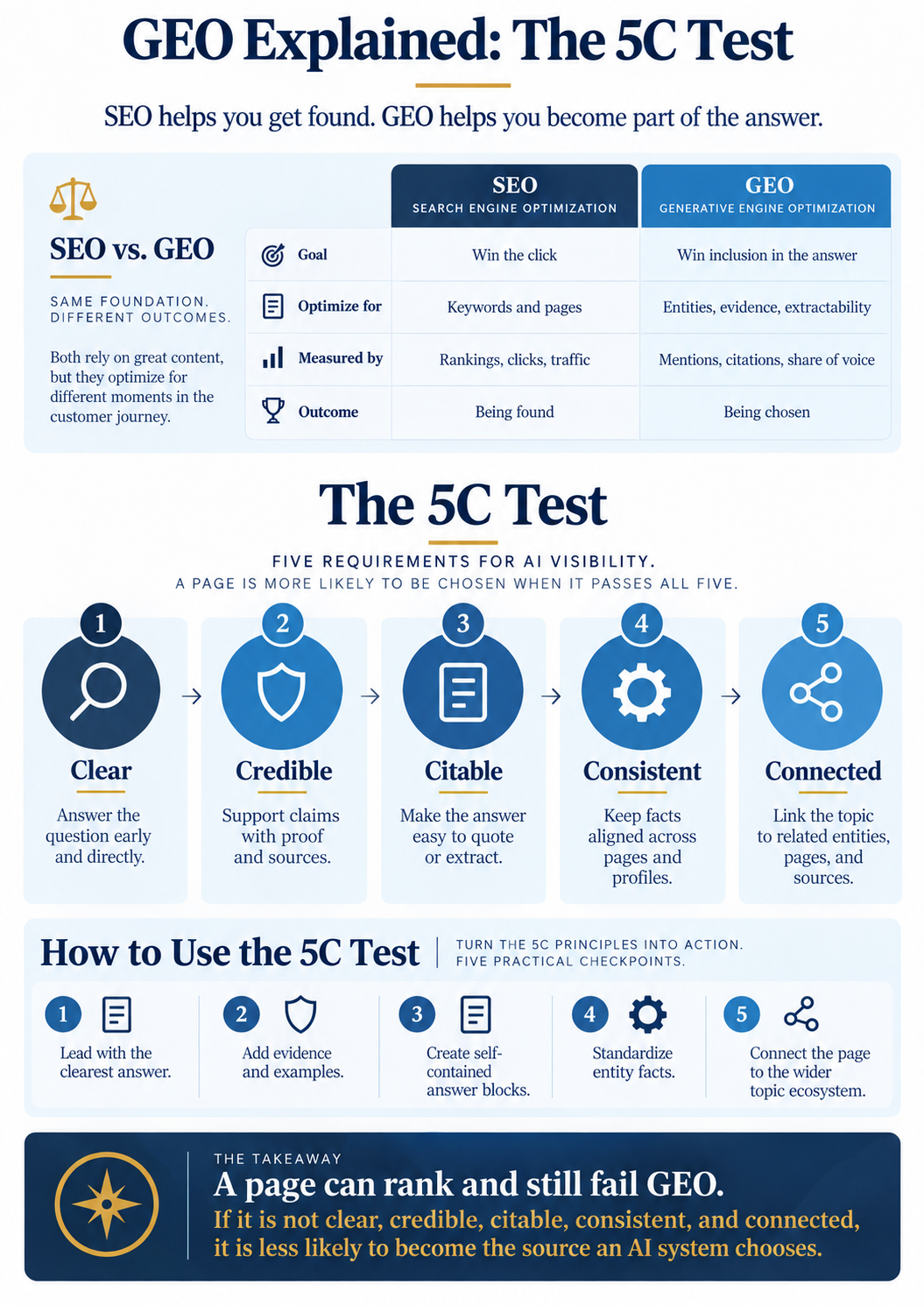
SEO and GEO overlap heavily because both depend on useful, accessible and credible content. The difference is mainly the outcome being measured. SEO usually asks whether a page can be discovered and ranked. GEO asks whether information from that page — and from the wider public record around the brand — is likely to be used, mentioned or cited in a generated answer.
That also changes how off-site authority is discussed. Backlinks remain important in search, but they are not the whole story in AI visibility. In Ahrefs’ study of 75,000 brands, branded web mentions correlated more strongly with visibility in Google AI Overviews than backlink counts did (0.664 versus 0.218). Ahrefs is explicit that this is correlation, not proof of causation, and later studies show that the pattern varies by platform.
The book compresses the distinction into a useful line: SEO makes content discoverable; GEO makes it usable. It is deliberately simple, but it captures the practical shift from ranking a page to supplying material that can be retrieved and incorporated into an answer.
How an AI Answer Gets Built
There is no single pipeline shared by every AI search product, and the vendors do not disclose every step. Still, a working model is useful because it shows where visibility can fail.
A query is interpreted and may be expanded into related searches. Candidate sources or passages are retrieved. Those candidates are filtered or reranked for relevance, freshness and other quality signals. The system then synthesizes an answer and, where the product provides citations, selects a smaller set of supporting links. Google confirms that AI Overviews and AI Mode may use query fan-out; other systems use different combinations of search, retrieval and model reasoning.
Retrieval-Augmented Generation, or RAG, is one well-known way to ground model output in outside information at query time. Search-connected assistants use retrieval in different forms, but the practical lesson is straightforward: content that cannot be reached or retrieved has little chance of influencing a retrieval-based answer.
The 5C Test: Five Questions Before You Hit Publish
The 5C Test is Scharfenberg’s own editorial checklist, not an industry standard. Its value is that it turns a vague question — “Is this page ready for AI search?” — into five concrete checks that also make the page better for human readers.
Clear: Can a reader identify the main answer quickly? Use descriptive headings, plain definitions and a direct opening instead of making the reader work through a long warm-up.
Credible: Can someone see who is responsible for the page and what supports its claims? Author information, dates, methods, sources, case evidence and transparent limitations all help.
Citable: Are the important points self-contained enough to quote or summarize accurately? Short answer passages, tables, definitions and specific figures can make that easier.
Consistent: Do the core facts about the company, author, product or service agree across the website and relevant external profiles? Consistency matters more than identical wording.
Connected: Is the page part of a wider body of evidence? Independent mentions, useful links, reviews, research, interviews and related expert content can give a claim context beyond the company’s own site.
Passing all five checks does not guarantee a citation. AI outputs are probabilistic and differ by platform, query and date. The point of the test is more modest: remove avoidable friction and make the page easier to understand, verify and reuse.
What These Systems Tend to Use Well
Some formats are naturally easier to parse because they answer a defined question in a compact structure: step-by-step instructions, clear definitions, FAQs, checklists, comparison tables and concise summaries. That is useful for an AI system, but it is also good editing for people who are scanning a page for an answer.
The book recommends putting a self-contained answer of roughly 40 to 70 words near the start of an important section. Treat that as an editorial heuristic, not a ranking factor. There is no official rule saying an answer must be that length; the purpose is simply to make the conclusion easy to find before the detail begins.
Tone deserves the same restraint. A neutral, specific paragraph is easier to verify than a block of superlatives and sales language. That does not mean an AI engine has a published “neutral tone” ranking factor. It means factual writing gives both readers and machines fewer reasons to question what a passage is claiming.
Visibility Doesn’t Stop at Your Website
GEO is not only an on-page exercise. Large citation studies repeatedly find third-party and community platforms among the sources used in AI answers — including Reddit, YouTube, LinkedIn and Wikipedia — although the mix changes sharply by engine and query. That is a good reason to look beyond your own domain without pretending every platform carries the same weight.
In practice, that means three kinds of work. Distribute useful expertise where your audience already spends time. Build authority through case studies, interviews, professional profiles and earned coverage. And make customer evidence easy to verify through appropriate review platforms and references. The goal is not to manufacture mentions; it is to leave a coherent public record.
An Answer Block in Practice: Before and After
The difference becomes obvious in an opening paragraph. A generic introduction such as “In today’s fast-changing digital landscape, businesses face many new challenges…” says almost nothing. It delays the point and gives neither a reader nor a retrieval system a clean answer to work with.
A stronger opening is simpler: “Generative Engine Optimization is the practice of improving content and public brand signals so AI search systems can find, understand and, where appropriate, cite them. It builds on normal SEO rather than replacing it.” The claim is clear, the limit is visible, and the rest of the article can now explain the evidence and the exceptions.
Frequently Asked Questions
Is GEO just a rebrand of SEO?
There is a real debate here. Google treats optimization for AI Overviews and AI Mode as part of normal SEO and says no special technical optimization is required. The term GEO is still useful when you need a broader framework for cross-engine citations, entity consistency, third-party evidence and prompt-based measurement. It is best understood as an extension of search work, not a replacement for it.
Does GEO help even if I ignore AI search?
Often, yes. Clear answers, named authors, current sources, consistent company information and balanced comparison content can improve usability and trust even when no AI system ever cites the page. That overlap is one reason sensible GEO work rarely needs to fight with sensible SEO.
Where should I start?
Choose one important page and run the 5C Test against it. Fix the weakest point first, then retest the real questions customers ask. A small repeatable experiment is more useful than rewriting an entire site around a theory you have not measured.
Conclusion
GEO is still a young discipline, and some claims around it are ahead of the evidence. The practical core is much less dramatic: keep the SEO foundation strong, make important answers easy to extract, show the evidence behind them, maintain a clear entity and measure what the major systems actually do. Scharfenberg’s 5C Test is a simple way to turn those principles into an editorial routine.
| About the author PhDr. Oliver Scharfenberg, MBA is Managing Director of the Syntharis Group and author of The AI Visibility SEO & GEO Playbook. His work focuses on marketing, employer branding, SEO, GEO and digital reputation. Further reading: “Why AI Cites You, or Doesn’t: E-E-A-T, Entities and Real Trust Signals” |