
How to Read Stock Recommendations: Entry, Target and Stop-Loss Explained
Stock recommendations are only as useful as the numbers attached to them. A view that says “buy this share” without an entry price, a target and a stop-loss is a stock name and little else, because the reader still has to guess where the idea starts to make sense, where profit should be booked and where the idea has failed. Knowing how to read stock recommendations in India, and how to decide whether to act on them at all, is one of the most practical skills a retail investor can build before putting money into the market.
What Are Stock Recommendations and Who Is Allowed to Give Them?
A stock recommendation is an analyst’s opinion on whether a company’s shares are worth buying, selling or holding, normally backed by a price level and a period. The quality varies enormously, from a one-line forward on a chat group to a detailed note that sets out the logic. Under Indian rules, a person who sells such opinions needs a SEBI licence as either a research analyst (registration numbers start with INH) or an investment adviser (numbers start with INA). A licence cannot make an opinion right, yet it attaches a name and a legal duty to every call, and that single feature is the quickest way to sort dependable stock recommendations from random chatter.
The format matters as much as the source. A reliable idea explains why the analyst likes or dislikes the share, states the period over which the view is expected to play out and gives levels that can be acted on. An idea without those basics may be directionally right and still be impossible to use, because the reader cannot tell when to enter, when to exit or how much to risk.
The Three Numbers Every Stock Recommendation Should Carry
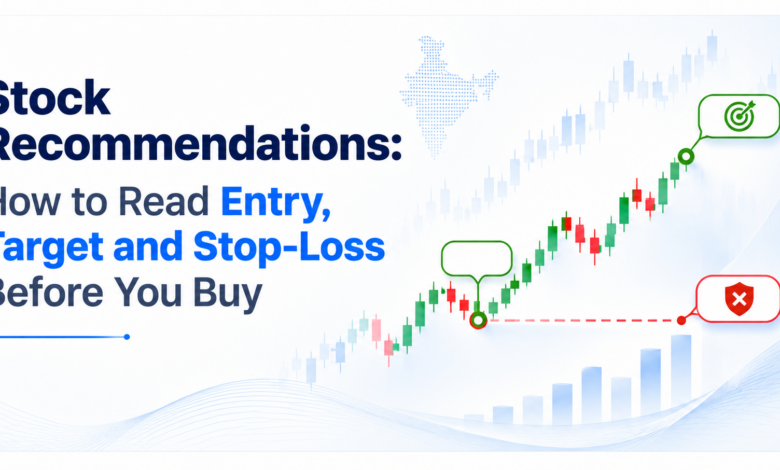
Think of the entry as the zone where the idea is valid. Buying inside the zone keeps the plan intact, whereas paying a much higher price turns the same idea into a different and riskier trade, even though the company is exactly what it was. The target marks where the analyst thinks profit should be taken, and some traders sell only half there and raise their protective order on the rest. The stop-loss marks the level that proves the idea wrong, and it is most effective as a live order entered along with the purchase. A level kept only in memory has a way of shifting once the market approaches it.
Put the three together and you get the risk-to-reward ratio, which tells you quickly whether a trade is worth the capital. A common benchmark is around ₹2 of potential gain per ₹1 of risk. At that ratio a trader who is right on just four trades out of ten can still finish ahead before charges. When a call puts more at risk than it can realistically earn, the success rate needed to break even climbs sharply, and stock recommendations of that kind rarely deserve a place in a portfolio.
How to Read Stock Recommendations With a Worked Example
Take an idea that reads: buy in the ₹200 to ₹204 band, aim for ₹220, exit at ₹194. Entering at ₹202 means about ₹8 per share at risk against roughly ₹18 of potential profit, so the reward is a little more than double the risk. Now picture the same share opening at ₹212 after thousands of subscribers received the alert together. A buyer at that level would be risking ₹18 to gain ₹8, which reverses the logic entirely. The company is unchanged, yet the trade is not, so the entry band should be read as a rule. If the price has run beyond it, let that idea go and wait for another.
How Many Stock Recommendations Should You Follow?
Probably fewer than you expect. When each trade puts one to two percent of your capital at risk, holding ten of them at once means ten to twenty percent could be exposed in one unlucky session. Following a small number of stock recommendations carefully usually beats trying to act on every notification. Two habits help. Pick only ideas whose time frame matches the attention you can give, since an intraday idea needs a screen, and log every trade in a simple notebook. Once you have about thirty entries, the log will show whether your source is genuinely useful or merely busy.
What to Do When a Recommendation Hits Its Stop-Loss
Allow the stop-loss to do its job, write down what happened and look for the next setup. The expensive habit is cancelling the order in the hope that the price recovers, which converts a small, planned loss into a large, unplanned one. Every analyst has losing calls, and a set of stock recommendations pays off only when each loss stays small enough for the winners to cover. Buying more of a falling share to bring the average cost down is a cousin of the same error, because it sends additional money after an idea the market has already turned down.
Are Free Stock Recommendations Worth Following?
They can be, provided the source passes the same tests as a paid one. A free idea from a SEBI-registered provider that includes an entry, a target and a stop-loss is more useful than a paid tip with none of those. What a paid service usually adds is consistency, a named team and a record you can audit, not certainty. Free ideas from anonymous social media channels sit at the other end: they rarely show a registration number, almost never publish their failed calls and are often a way of building an audience that is later sold something else. Whatever the price, the fee, the notice period and the refund terms should be stated clearly before you pay.
Red Flags to Watch for in Stock Recommendations
Guaranteed returns are the clearest warning, because no registered provider is allowed to promise them. Others include pressure to act within minutes, requests to send money to an individual’s personal account, profit-sharing offers, screenshots of winning trades with no registration number and ideas that never mention a stop-loss. Any one of these is reason enough to step back, and a combination of two or three should end the conversation.
How Long Should You Hold a Share After a Recommendation?
Until the target or the stop-loss is hit, or until the time frame given with the idea runs out. If a short-term idea has gone nowhere by the end of its stated period, closing it is usually the cleaner choice, because capital tied up in a stalled trade cannot be used for the next opportunity. Turning a failed trade into a long-term holding is a common and costly habit, since the original reasoning was built for a different purpose. Judge every idea against its own plan, and keep long-term investing decisions separate from short-term trades.
Do Stock Recommendations Differ for Intraday, Swing and Long-Term Ideas?
Yes, and the difference shows up mainly in time frame and in how wide the stop-loss is. An intraday idea expects the trade to be closed the same day and uses a tight stop. A swing idea runs for days or a few weeks and needs more room for ordinary price movement. A long-term idea is built on the quality of the business and is judged over months or years, so its exit often depends on a change in the company’s prospects and not on a single price. Reading the time frame first prevents the common error of applying a short-term stop to a long-term holding, or the reverse.
Where to Find Stock Recommendations You Can Trust
Start with three checks: a SEBI registration number that matches the name of the firm, a named research team and a record of closed ideas that includes the losing ones. A provider that shows only winners is curating its history instead of reporting it.
Univest, for example, is a SEBI-registered research and broking platform that operates under Research Analyst, Investment Adviser and Stock Broker registrations. Its trade ideas each carry an entry, a target and a stop-loss along with the reasoning behind them, and they reach the phone as alerts, alongside buy, sell or hold ratings on more than 2,000 stocks across NSE and BSE. Subscription pricing is shown upfront. Whichever source you use, judge it over twenty or thirty ideas and not just three. Visit univest.in or download the investing app.
Conclusion
Stock recommendations are worth following only when they come with an entry, a target and a stop-loss, a visible SEBI registration and a record that includes losses as well as wins. Reading the numbers before acting, keeping position sizes small and judging a source over many ideas instead of a few will protect capital far better than chasing any single call.