7 Best Ways to Track Equipment in a Shared Workshop
A practical, honest ranking of seven ways to track shared workshop equipment, from QR checkout software to the paper logbook on the sign-out desk.
For most shared workshops, the best way to track equipment is a QR label on each item backed by simple checkout software: the borrower scans the label with their phone, types a name, and picks a due date. Labeled storage locations, color-coded tags, and asset registers earn places below it, while whiteboards, spreadsheets, and paper logbooks only suit very small shops.
I ran a community workshop for four years, and I can tell you exactly how tools leave. Someone borrows the cordless drill for a home job, and the drill now lives in their truck. The good bit set walked out in January with a member who stopped coming in February. The router came back with a cracked base plate and nobody saw anything. The problem is never malice. It is that shops run on shared tools and nobody records the borrow, because the record always lives somewhere inconvenient and the borrow happens at the bench.
How this ranking was built: I judged each method on four things. How fast is it to record a loan? Does it survive volunteers, new members, and the Saturday rush? What does it cost? And what happens when something goes missing? Match the method to the size of your shop and how often gear actually walks off.
The seven methods at a glance
| Method | Cost | Effort to run | Best for |
| QR labels + checkout software | Free up to 50 items, then $79/mo | Low | Most shared workshops |
| Labeled storage locations | Foam, paint, labels | Low | Visual inventory |
| Color-coded tags by crew | Paint or tape | Low | Multi-crew shops |
| Asset tags + serial register | Labels + a spreadsheet | Medium | Insurance records |
| Shared spreadsheet | Free | Medium | Very small teams |
| Whiteboard sign-out | A whiteboard | Low but constant | One-room shops |
| Paper logbook | A bound notebook | Medium | Tiny formal shops |
Quick ranking
- QR labels with checkout software — the only method where the record happens at the moment of borrowing.
- Labeled storage locations — a missing tool is visible at a glance, with zero ongoing effort.
- Color-coded tags by crew or trade — cheap, instant ownership that works even when nobody logs anything.
- Asset tags and serial number registers — insurance-grade proof of ownership that pairs with any other method.
- Shared spreadsheet — searchable and free, but it still depends on someone filling it in at the bench.
- Whiteboard sign-out — fast and visible, until the day it gets wiped.
- Paper logbook at the sign-out desk — the honest last place: it works until the person who enforced it leaves.
1. WhoHasGear.com — QR labels plus checkout software
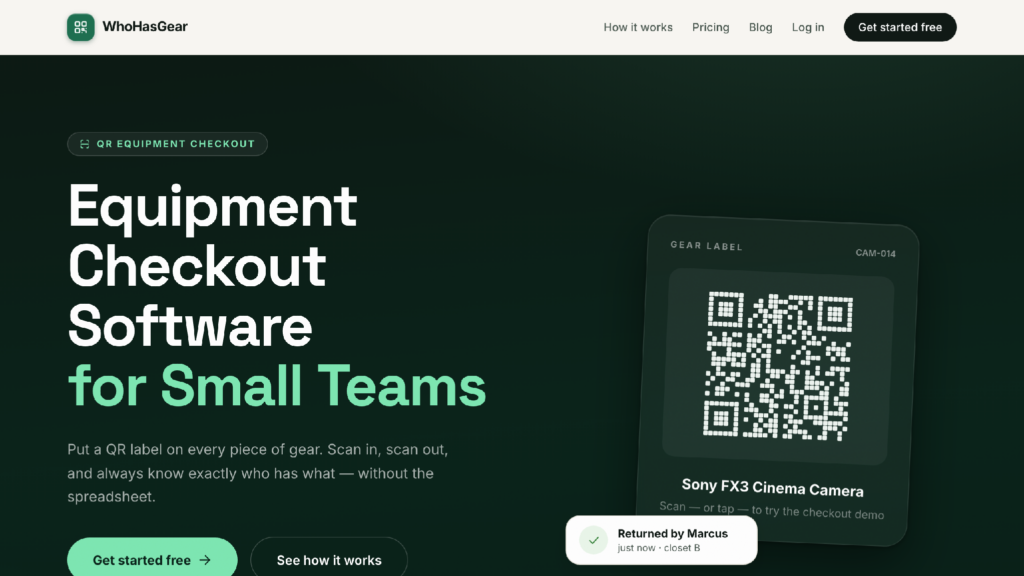
WhoHasGear.com homepage
The method is simple. You print one QR label per item on ordinary Avery-compatible label sheets, using software that generates the codes for you, and stick one on each tool, case, or drawer. A borrower scans the label with their phone camera. No app, no account: the code opens straight to that item, they type a name, pick a due date, and walk off with the tool. WhoHasGear is a responsive web app built around exactly this flow.
Why does this rank first? Because the record happens at the moment of borrowing. The label is right there on the tool, so nobody has to remember to update a spreadsheet later or walk to the sign-out desk. In my shop, every system we tried depended on someone remembering. QR labels are the only method where doing the right thing is easier than not doing it.
Once items are checked out, the software keeps a live board showing what is checked out, due today, reserved, overdue, and available, with overdue items surfaced at the top. Reservations block double-booking, which ends the Saturday argument over the one working track saw. Every item keeps a full custody history: who had it, when, and what shape it came back in, with damage notes and photos, plus export. That custody record is what finally settled our cracked-base-plate disputes.
Where it wins: speed at the bench and a record that survives volunteers, new members, and staff turnover.
Watch out for: label adhesion is real work on dusty benches and painted steel; wipe with isopropyl first, laminate labels on high-touch items, and test a spot on metal tools before committing.
Free plan: free up to 50 items with your whole team, no credit card; paid plans start at $79/mo priced by inventory size, never per person.
2. Labeled storage locations — a place for everything, no borrower record
Labeled storage locations are the shadow-board method: every tool has a painted outline, a foam cutout, or a labeled hook, so a missing tool is visible at a glance. It costs almost nothing and takes zero ongoing effort once it is built. For a fixed set of shop tools, this is the fastest visual inventory you can buy.
Our shadow board looked great for a month, and I still think it is underrated. It teaches new members where things live without a word of instruction, and it makes an empty outline shout across the room. When the fire marshal wants a walkthrough, you can audit a bench in ten seconds. The Saturday volunteer who returned everything at once could find the right home for each clamp because the board told him.
The limits are just as clear. The board tells you something is missing, not who has it, and it does nothing for gear that leaves the shop on a truck. Our board also drifted: tools got improved, new tools arrived, and the foam never got recut. A shadow board is a snapshot of the shop as it was, and snapshots age.
How it compares: it catches losses instantly, but it cannot answer the question the board poses, which is where the missing item actually is.
Watch out for: budget a half-day to recut foam and repaint outlines whenever the inventory changes, or the board becomes a lie.
3. Color-coded tags by crew or trade
Color-coded tags mean a band of tape, a paint ring, or colored vinyl on every tool handle, with each color standing for a crew, trade, or storage area. Woodshop blue, auto red, AV yellow. It is the cheapest method here and it works even when nobody logs anything, because ownership travels on the tool itself.
I like color coding as an ownership signal more than as a tracking system. A tape band on the handle of a framing square means anyone can return it to the right corner without asking, and a borrowed tool in another crew’s area announces itself. It survives messy weeks precisely because it demands no logging at all.
The limits show up when you need an answer. Color tells you whose it is, not where it is, and a tool that left the building takes its color with it. Tape fades and peels, paint chips off oiled handles, and every new member needs a legend taped somewhere visible. Keep a one-page legend by the door or the system quietly dies.
4. Asset tags and serial number registers
An asset register is a numbered tag on each item, engraved or stamped, backed by a master list of serial numbers, purchase dates, and values. This is the insurance-grade method. It is also the one that works alongside every other method on this list rather than instead of them.
The register earns its keep in two moments. After a break-in, a serial list is what police and insurers actually want, and engraved numbers make resale of stolen tools harder. For nonprofit shops and school programs, a documented register also supports grant reporting and claims, because you can prove the miter saw existed and what it cost.
The honest limit: proof of ownership is not live custody. Nobody checks the register at the moment a tool leaves the shop, so the register never tells you who has the router. It is a spreadsheet discipline, and it goes stale the same way any spreadsheet does. Update it annually at minimum, and treat it as a foundation, not a tracking system.
5. Shared spreadsheet
A shared spreadsheet is the step up from a whiteboard that most shops try next: a Google Sheet or Excel file with a row per tool, columns for borrower, date out, and date due. It is free, searchable, sortable, and better than a whiteboard because it keeps history instead of wiping it.
Its failure mode is identical to the whiteboard’s, though. The record still depends on someone filling it in at the bench, and the row for the borrowed router is still empty two weeks later. Walking to a computer, or even unlocking a phone to edit a shared file, is friction, and friction loses to muscle memory every time.
Spreadsheets add their own problem once a shop grows: version conflicts. Two people edit at once and one overwrite quietly erases the other’s rows. My verdict is that a spreadsheet is fine for a very small shop with one careful person, and a trap for everyone else. If you already run one, put the QR method’s export on top of it rather than feeding it by hand.
6. Whiteboard sign-out
The whiteboard is the classic shop wall: columns for item, name, date out, and a wipe of the row on return. It is fast, free, and visible to everyone, which is why nearly every shared shop tries it first. I am not going to pretend ours was useless; it worked for a long time.
The failure is structural. A whiteboard has no history, so you cannot answer who had the impact driver in March, and there is no reminder when a loan runs long. Nothing gets reserved, so the double-booking argument never resolves. And it fails the moment it is not updated, which is every busy week, because updating it competes with the actual work.
Then there is the day I remember most: the whiteboard got wiped for a fire-marshal visit, three weeks of sign-outs gone in one pass. Nobody had photographed it. The person who erased it is never the person you need to ask. A whiteboard is a good notice board and a poor ledger, and shops that treat it as the ledger lose tools.
7. Paper logbook at the sign-out desk
The paper logbook is the traditional method: a bound book at the desk where every borrower signs out an item by hand. Many trade shops still run this way, and it has real strengths. Setup is a pen and a book, it costs almost nothing, the physical signature creates genuine accountability, and it works during power cuts and wifi outages.
I rank it last anyway, and here is why. A logbook is a single point of failure: the book is lost, soaked, or full and nobody has a spare. There is no backup and no reminders, so overdue loans surface only when someone misses the tool. Handwriting degrades into guesswork within a season. You cannot search it, sort it, or reserve against it.
It also dies the day the person who enforced it leaves. Every logbook I have seen worked because one person stood at the desk and made people sign, and when that person moved on, the book filled with blank rows. If your shop is two or three people who see each other daily, a logbook is honest and fine. Past that size, it records the past and predicts nothing.
How to choose the right method for your shop
Start with size. A shop of five or six regulars can run on labeled storage plus a whiteboard, because everyone sees everyone daily. Past about ten people, or any time volunteers and new members flow through, memory stops working and you need a record that captures itself. That is the honest dividing line I watched in my own shop.
Then ask what actually goes missing. If tools never leave the building, shadow boards and paint outlines catch most losses. If gear regularly goes out on jobs, to members’ homes, or to a film shoot, you need a method that travels with the item, which is what QR labels do and what boards cannot.
Finally, be honest about who maintains it. I layered all three cheap methods at once: outlines, color bands, and a binder, and the binder was empty by spring. The method that survives is the one where the easiest thing to do is also the right thing, so pick accordingly and add a serial register underneath for insurance.
Frequently asked questions
Q: What is the best way to keep track of shared tools? A: For most shared workshops, QR labels plus checkout software is the best way: each item gets a printed label, borrowers scan it with a phone camera, type a name, and pick a due date. The record happens at the moment of borrowing, so it does not depend on anyone remembering to update a board or spreadsheet later.
Q: How do I stop tools going missing from my workshop? A: Layer two cheap measures with one real record. Give every tool a labeled home or color band so ownership is visible, and keep a serial number register for insurance and theft recovery. For gear that leaves the building, add a checkout record such as a QR label so each loan has a name and a due date attached.
Q: Is a whiteboard good enough to track equipment? A: For a small shop where everyone sees the wall daily, a whiteboard is adequate for sign-outs. It fails as a full system because it keeps no history, cannot set reminders, cannot take reservations, and is wiped clean by a single pass of a cloth. Most shops outgrow it once regular members exceed about ten.
Q: How do QR code labels work on tools? A: A QR label is a printed sticker with a code unique to one item. A borrower scans it with their phone camera, no app or account needed, and the code opens that item’s page. They type a name, pick a due date, and the loan is recorded. The tool then shows as checked out, reserved, or overdue on a shared live board.
Q: Do I need software to track a small workshop? A: Not necessarily. A shop under about ten people with gear that never leaves can run well on labeled storage locations, color tags, and a simple sign-out sheet. Software earns its cost when gear regularly leaves the building, when you need reservations, or when volunteers and turnover make memory and paper unreliable.
Final verdict
I have tried the whiteboard, the binder, the shadow board, and the spreadsheet, and I would run one system if I started again: QR labels plus checkout software, because it is the only method that survives contact with actual volunteers. Labeled storage locations and color-coded tags are worth doing as complements, since they make the shop legible to newcomers, but they cannot tell you who has the missing tool. Keep a serial register underneath for insurance. The paper logbook only suits very small crews with one person willing to stand at the desk, and the day that person leaves, it dies with them.