How to Read a Blackjack Basic Strategy Chart
How to Read a Blackjack Basic Strategy Chart
Blackjack is the rare casino game where your decisions actually move the needle. Play every hand by feel and the house takes roughly 2% of everything you wager. Play the mathematically correct move every time and that edge collapses to around half a percent. The tool that gets you there is a blackjack basic strategy chart — a grid that tells you the single best action for any hand you can be dealt.
What the grid actually shows
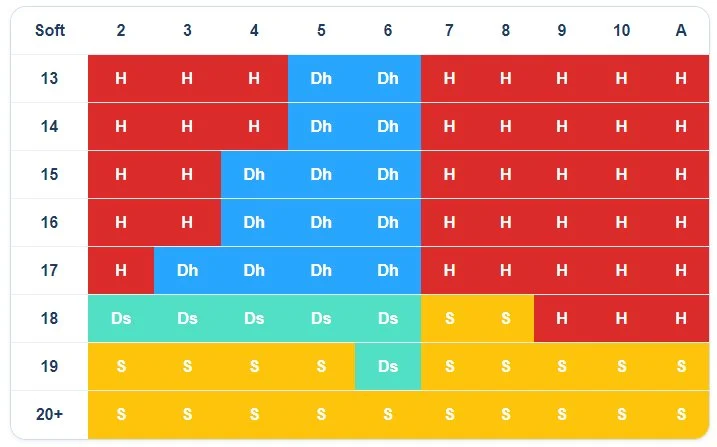
Every basic strategy chart is built the same way. Your hand runs down the left side; the dealer’s upcard runs across the top. Where the two meet, the cell tells you what to do:
- H — Hit
- S — Stand
- D — Double (or hit if doubling isn’t allowed)
- P — Split
- Some charts add Ds (double if allowed, otherwise stand) and surrender codes
The chart is split into three sections that you read slightly differently: hard totals (no ace, or an ace forced to count as 1), soft totals (a hand with an ace still worth 11), and pairs (two cards of the same rank, where splitting is on the table).
The logic you can feel
You don’t have to memorise the grid blindly — most of it follows one idea: the dealer’s upcard tells you how likely they are to bust. A dealer showing 2 through 6 is in trouble; those are the “bust cards.” Against them you play cautiously, standing on stiff totals and doubling your strong ones to punish a weak dealer. A dealer showing 7 through Ace is strong, so you keep hitting until you have a hand that can compete.
That single principle explains most of the chart. Stand on 12–16 against a dealer 2–6; hit those same totals against a 7 or higher. Always split aces and eights. Never split tens. Double 11 against almost anything.
Rules change the chart
Here’s the part casual players miss: there is no single “correct” chart. The right moves shift with the table rules. Whether the dealer hits or stands on soft 17, how many decks are in the shoe, whether you can double after splitting, and whether surrender is offered — each of these nudges a handful of cells. A chart built for a single-deck, dealer-stands-on-17 game will be slightly wrong at a six-deck, hits-on-17 table.
That’s why a static printed card only gets you close. A blackjack chart maker lets you set your exact table rules and generates the precise chart for that game, so you’re not memorising a version that doesn’t match the felt in front of you.
How to practise
Reading a chart at your kitchen table is easy; recalling it under pressure is the hard part. Drill the borderline hands first — the 12s through 16s and the soft 17s and 18s, where most money is lost. Once those are automatic, the rest of the chart is mostly common sense. Print your rule-specific chart, keep it beside you while you practise, and within a few sessions the moves become muscle memory.
Basic strategy won’t make blackjack a winning game — the house still keeps its thin edge — but it turns a 2% leak into a 0.5% one. Over a year of play, that difference is enormous.